Mr Li Xianting: greetings!
As a matter of my overall conception of art, I believe that art is a process of testing (or perhaps, supplementing this word with words of similar meaning: a practice, practical experiment, attempt, possibility of discovery and so on).
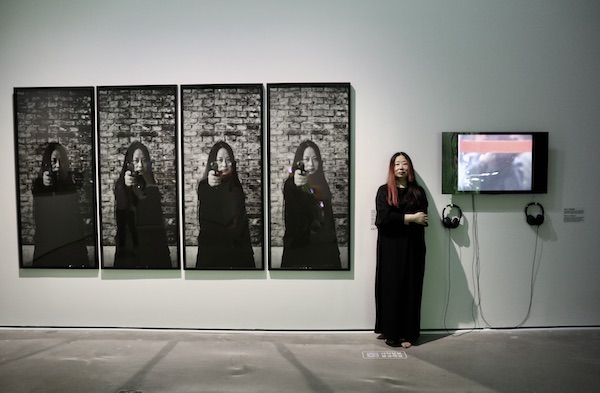
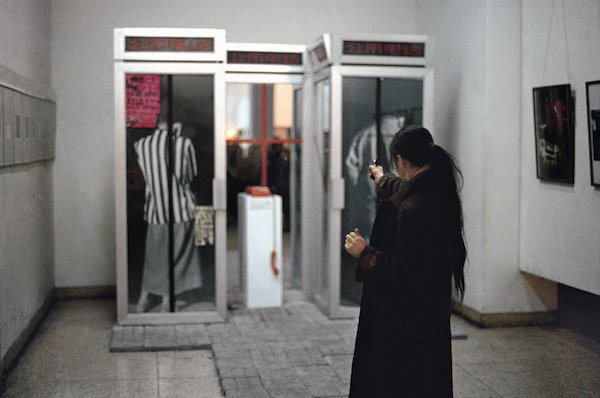
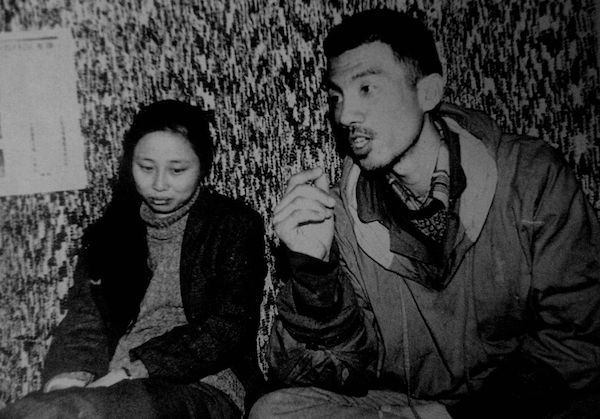
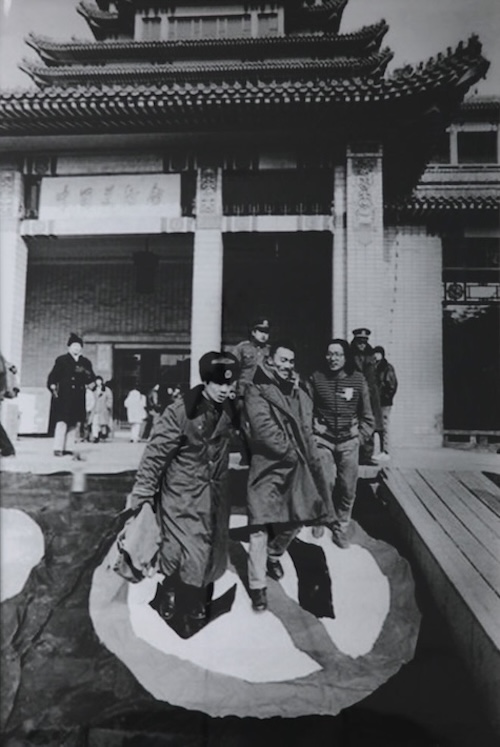
This practical experiment may display some uncommon characteristics due to some similarity to certain ‘cases’ or ‘events’ in social life. This is also what I want from the ‘potential’ characteristics in the ‘incident’, and this artistic work completed by a man and a woman may also be called an ‘artist’s practical experiment’. (All my previous work is like this, with the only difference being the object of the experiments).
The unique characteristics revealed by this experiment, perhaps through similarity with certain “cases” or “incidents” in social life, these are also the special character relating to “potentiality” that I’m after.
First, the “incident” as art that is designated as such by the artist, and, directly or even indirectly, the “situation” linked with the incident, are all forms that are overshadowed by the action of the artist. To understand this art, it is enough for us just to understand these situations, we must just understand – or even just know this “incident”. Why can we not trust that art one day will merge with social life? Artists will become a part of social life, and the form of being art will also come alive. From this point of view, the hearer of the Way will also be the shower of the Way, and the shower of the Way will at the same time be a hearer of the Way.
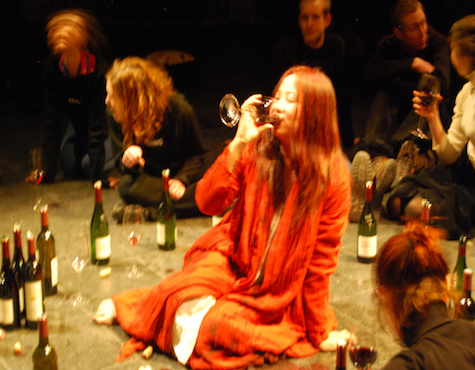
To be a direct producer (formulator, creator), one must first of all take society as a reference for one’s artistic experiments, for the two of them as artists are also, objectively speaking, referencing a specific historical society. From this point of view, the producers of “incidence art” have come to find society as this point of reference within the “big machine” of society. One could also say that it is to find the object of reference within the big cycle of society. From a certain angle, being an artist as such also means making oneself the object of satire. (Someone said that the artists had produced this “incident” as a satire on all the other artists in the exhibition) (if this “incident” has a satirical meaning, it is as a satire on both Tang and Xiao themselves. Zhuangzi has a story about a mantis catching a cicada, an oriole does the same to the mantis, and the man holding the bow has just realised how the watchman of the garden will act. The way of thinking involved in this relative consideration of problems can be referred to here, in this way of breaking clear of the thought values of the original self).
In the appearance of art as a face of social life, the artist as such must place himself in the social life situation which he has produced (I believe that people who equate the “incident” with destructive art, performance art or randomized art in order to understand it will get nothing from “incident” art). In the collaboration between Xiao Lu and myself this time (I could not have completed it personally) it was necessary that we truly entered into it personally, and that might be compared to our being placed in a large blender and turning the switch on. The artists in this case could be termed the “thing being blended” (the more real the blending, the more truly it can produce the real social art that I envision). Otherwise, for art to really be turned into social life, it can only be into an individual life. (Of course, my artistic values are, always were and always will consider that art is established in individual life, even in individual spiritual life. But it must be placed in the premise of the social life aspect of art.)
Facing the reality of the age: the acceleration of time, the contraction of space, as well as the rise of the possibility of the destruction and disappearance of the world, the work undertaken by the artist is founded in a corresponding mental level, and the closed-off artistic psychology will be unable to wield the creative purpose of art as this most sensitive nervous system of human society. But the social enlivening of art will allow art and artists in the society of this age to soar as a seagull over the waves, ever faster as it flies, until it finally becomes a transparent body.
Art as “incident” is like incident as “art”, and socially activated art and society as activated art are both ultimate goals that I dream of. In this art can truly be known, not as a matter of experience, for art in this ideal sense cannot be destroyed. It can only become more and more transparent against the background of the reference object of social life.
Mr Xianting, maybe you too, Sir, too have noticed that the “incident” used some kind of technique. What Sunzi refers to as defeating an enemy’s weapons, army and state without waging war is an ideal theory created on the basis of a big way of thinking. One might also say that defeating an enemy’s state without waging war is the ideal of foreign ministers and politicians. But what I have seen is that there is no comprehensive, long-term and fundamental study of the real object of attention, nor any predictive judgment on all the possibilities of the target that must be mastered in the analytical knowledge of history (such judgments are often founded on the basis of many possibilities), and that this makes all talk of defeating an enemy state without waging war empty.
Art always requires technique, including deception. Yet the artists who make such devices their end goal are to be pitied. Laozi/Zhuangzi and Sunzi perhaps are the two most extreme essences of Chinese culture, that is, the essences of non-practical thinking and of practical thinking.
Art in social life can be called the transparent structure of glassy character, and instead of losing itself (which is objectively impossible), it allows itself to become even more sensitive, even more irreplaceable, and the development of human civilisation to become more possible. Laozi/Zhuangzi realized the Way, and that it has eternal civilizational significance in itself when human beings themselves enter into the cycle of the natural ideal, where Western civilisation in this respect is just like an annotation made on Laozi and Zhuangzi.) Where Sunzi’s Art of War on the other hand has helped me lies in providing methodology of reference for the realistic character of China’s civilisation
Mr Xianting, the more important part of what I am talking about is that I want to increase your and my mutual understanding. I also wish to understand your overall view of art and your take on questions relating to history, art, culture, society and so on.
As for Nest (巢) (I don’t know who came up with this title), the title that I gave it was Trap (圈套). It was created in June-July 1988, approximately 350x150x280 cm, using 1000 matches, yarn, brown rope and the brown single bed in which I had slept for ten years. I created something secure but lonely, and used in the creating process a method that was bound to destroy the work. These two opposite ideas could never blend, any more than water and fire, and it was also like good fortune and disaster depending upon each other, or like the way everything people do is in order to develop and progress – or are they digging their own grave? Who knows?!
Hypothesis of Hypotheses (假设之假设) was founded on the basis of empiricism/positivism. You have all the materials, photographs and negative film there. I have sent you all the notes. This work can never be photographed again. nor can photographs capture the natural fluttering effect of the magnetic tape.
This model and the notes made in the Ark cafć both produce a partial social effect. Ordinary people in their lives still reflect the hope that art should be something high above them. This work aims at causing this not to be altogether the case.
The works of the sheet-iron kind are also all in your possession. These works, and the chopstick works were all completed in the first half of 1988. The experimental nature of the sheet-iron lies in a process that is seriously boring. I believe that it is ridiculous that there are people who apply an interpretation of the works of that era in “purified language”. (Regardless of whether the developments in contemporary linguistics are empirical or phenomenological, they regard language as important and full of relativity. The term “purified” reflects that the level of certain art workers is very low, and their understanding of art is very naive. The development of modern art has long since passed the time of concern about the linguistic issues of art, just as it would be ridiculous still to argue for the modern significance of the eight-legged essay now that the vernacular way of writing has reached its present stage.) Carefully beating a chair that is flattened below, or a sheet of iron of half a table is boring in the eyes of many “people living ordinary lives”, and when such works are placed in an exhibition hall of the Shanghai Art Museum, the indignation of these “people living ordinary lives” tells me (I was once surrounded by more than thirty people belligerently demanding whether or not this art was like a small child peeing) that these thingummies are indeed rather boring. All these works may be called works of “untitled processes”. (At the time, all their titles were given as “Untitled”).
Among the things of other periods, I think the most important is the slideshow of an album that was once shown at an exhibition in the Netherlands. I personally think that these works, for now, can only serve as introductory processes without any other value.
Mr Xianting, I regard a human life, or rather my own individual life as a test product, a test product with artistic affinities. One ideal is to go in the opposite direction of your goals, “heading north to get to the south”, until you finally arrive at your starting point. Perhaps that was the ultimate awareness of human life at the time. Process is the background of the destiny of human life. Life is neither a glorious process, nor altogether the result of returning to the starting point from whence one set out. As I see it, the transparency of seagulls is the ideal, and is also a positively rational symbol of human life. “Heading north to go south” in the view of an artist is the art of life and is also an eternal meaning of life. The knowledge of the true track of life.
So much for now.
Best wishes,
Tang Song
21 June, 1989
Translation from Chinese by Archibald McKenzie 2024