1.The origin of the installation work Dialogue (对话)
In 1988 I was a student in the 1988 graduation class of the Oil Painting Department of the Zhejiang Academy of Fine Arts (now the China Academy of Art)1 and had embarked on the tense period of creating my graduation work. My graduation class supervisors were Zheng Shengtian (郑胜天)2, Hu Zhenyu (胡振宇)3 and Wang Chengyi (汪诚一)4.
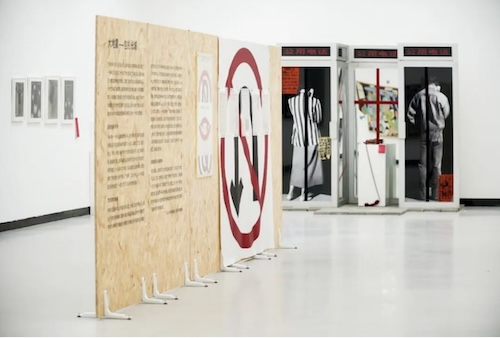
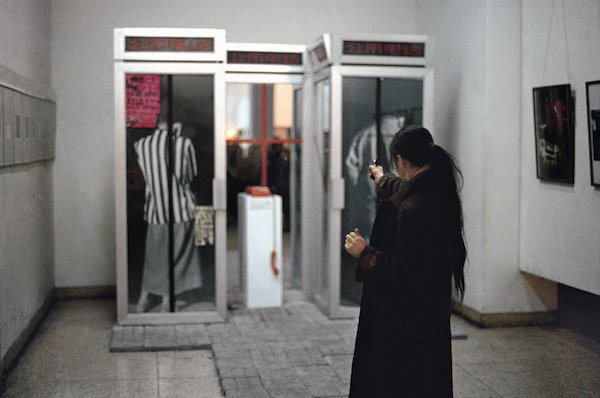
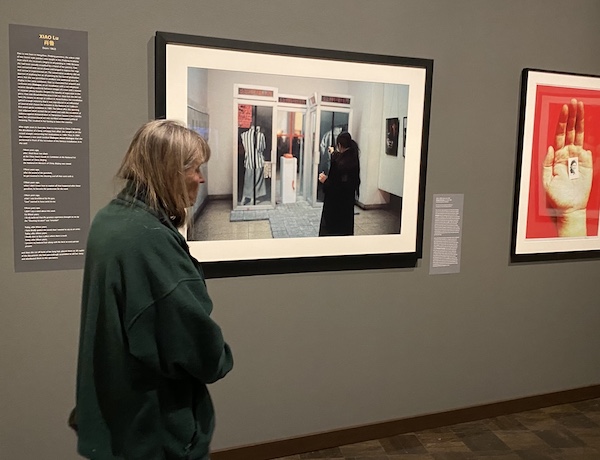
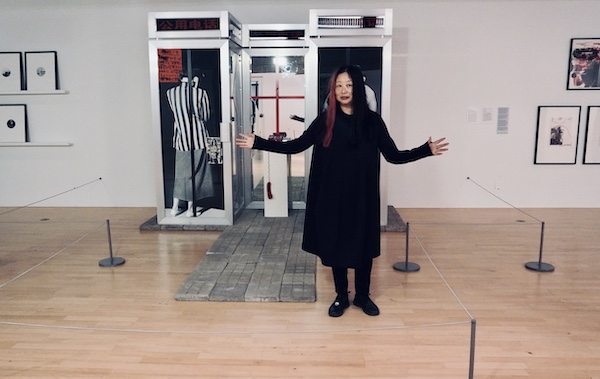
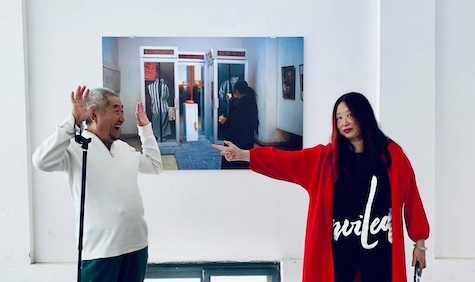
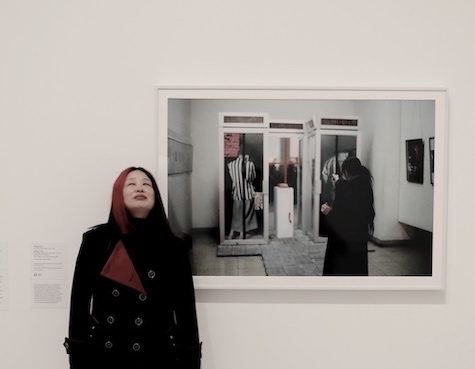
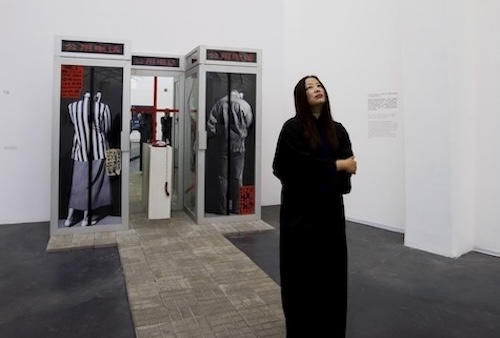
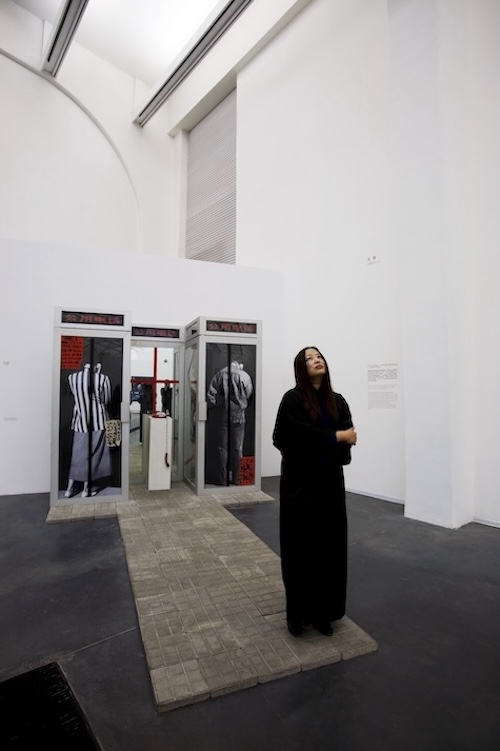
The first sketch that I submitted to my supervisors was a couple, a man and a woman, on a phone call. The telephone booth was made of aluminium alloy, and the male and female figures were painted. It was an extension of a creative idea that I had had since second year, half materials, half painting. It was my supervisor Zheng who led me to use the device of using a black and white photograph to replace the painting.
The original creative impulse behind the work Dialogue came from my personal emotional losses, especially through a #MeToo5 experience that had trapped me in an extremely stressed state. It was like what was expressed in the work, a man and a woman on the phone, with the dangling receiver clearly telling viewers that the call wasn’t coming through. This desperate yet yearning contradictory psychology as the original motive behind the origin of Dialogue.
When the Oil Painting Department vetted this proposal, it wasn’t accepted. Finally, thanks to the advocacy of my class teacher, it was agreed that I could paint an oil painting as a graduation work, with my installation Dialogueserving as reference marks. That’s what I did: my graduation works were, separately, the oil painting Red Wall(红墙) and the installation Dialogue.
In order to employ aluminium alloy materials that were like the real telephone booths of that time, I went through the contacts of my father Xiao Feng (肖峰)6 to make contact with the Hangzhou Telecoms Office, hoping to gain their support. Ultimately they supplied an entire telephone booth constructed in aluminium alloy according to my design and finally took part in the work of assembling it.
When the installation work Dialogue was completed, it aroused the curiosity of many teachers and students at the Zhejiang Academy of Fine Arts, and they came to see this work. My strongest impression was the occasion when the Crafts teacher Song Jianming (宋建明)7 came to see it. His initial impression was that the work was too “clean”, and that it needed some breaking up. So we discussed how one could go about this “breaking up”. The glass mustn’t be smashed, yet there should be traces of breaking, so the velocity was an important factor, and we came up with the idea of using a gun to shoot it, without however knowing how to go about it in practical terms. At the time, many of the teachers who saw this work offered various casual suggestions, but it was only that conversation with professor Song Jianming that left me continuously excited about shooting the work with a gun, and it was related to the element of hatred underlying my creation of this work. After a while, I asked a friend Sha Yong (沙勇) who lived in the dormitory of the Academy of Fine Arts and who was a member of the Zhejiang provincial shooting team to lend me a gun, and he said he’d see.
In the 1988 Graduation Exhibition at the Zhejiang Academy of Fine Arts, Red Wall and Dialogue were exhibited at the same time. Sha Yong had borrowed the gun on the day, but he only had three hours in which to return it. In those days we didn’t have mobile cell phones with which to communicate, and he couldn’t find me in time. I found out about this afterwards and abandoned the idea for the time being.
After the Graduation Exhibition, the work Dialogue was published on the back cover of the October 1988 edition of Art Magazine (美术), and on the title page of New Art Magazine (新美术) in 1989.
2.The work Dialogue is selected for the 1989 China/Avant-Garde (中国现代艺术展)
In 1988, I was seconded to work within the Shanghai Oil Painting and Sculpture Institute8. When I received notice that the work Dialogue had been selected for exhibition in the China/Avant-Garde9, I was both excited and surprised. For I hadn’t applied for this work to be included, and only learned afterwards that it was Zhang Jie (张捷)10 of the Chinese Painting Department of the Zhejiang Academy of Fine Arts, who at the time was engaged in “wall newspapers” with an avantgarde bent, and who was fairly well acquainted with some of the people on the exhibition committee, who at a conference in Huangshan had selected and shown some slides of works originating in Zhejiang. When the slide of my work Dialogue was shown, it was selected by the preparatory committee of the China/Avant-Garde to be shown at the Exhibition.
At the time, the installation work Dialogue was stored in Hangzhou. I travelled from Shanghai to Hangzhou to sort out the freighting of the work. I happened to bump into Tang Song (唐宋)11 at the Ark Café next to the Zhejiang Academy of Fine Arts. I knew who he was, but we weren’t close. In casual conversation I learnd that one of his works, Nest (巢) had also been selected for exhibition in the China/Avant-Garde, so we had more to talk about. I mentioned my earlier 1988 plan of wanting to shoot the work. I hadn’t arrived at a decision as to whether I would shoot he work at the China/Avant-Garde, because I didn’t know whether I’d be able to borrow a gun. I had thought of asking Li Songsong12 whether he would lend me one.
I knew Li Songsong through my late maternal grandfather Song Cheng (宋澄)13. He and Li Songsong’s paternal grandfather Li Yaowen (李耀文)14 had been comrades during the war. In the winter of 1941, my grandfather unfortunately died of sickness, and my mother Song Ren (宋韧)15 became a Martyr’s Orphan. Now Li Songsong’s grandfather took especial care of my mother. It was because of this relationship that when I was studying at the Subsidiary High School of the Central Academy of Fine Art in Beijing, Li Songsong’s grandfather showed particular concern for me. I often went to their house and gradually began to teach their grandson Li Songsong painting. At the time he was only seven or eight years old, and I remembered that he had shown me a gun. Later I found out that this gun was a war souvenir of his maternal grandmother’s.
At the end of January, 1989, the work Dialogue was freighted to Beijing. When I was registering the work at the National Museum of China, the person who received me was Yin Shuangxi (殷双喜)16. At the time he was in charge of registering artists and their works for participation in the exhibition. As I remember it, when I was registering, I entered the name Xiao Lu and the work Dialogue, and hnded over 100 yuan RMB as an exhibition fee. Before the installation, I asked Yin Shuangxi about the concrete flagstones to serve as the base of the work, and he suggested having a look around in the street. Later I actually found some ready-made flagstones in the shape of a noughts-and-crosses square and used them during the installation.
While I was in Beijing, I went to Li Songsong’s house. We went into the city together, and on the bus we talked about the matter of his lending me the gun. He said it would be no problem, and we decided that I would ring him the day before the exhibition.
Tang Song arrived in Beijing. I met him and found out that he had not brought Nest, his work for the exhibition. I asked him why not, and I remember that he said then that when he had heard about my idea of firing a gun, he suddenly felt that his own work was not very interesting, and that he would have a think about other possibilities when he got to Beijing and decide then. He said to me that he wanted to get an ambulance to the square of the National Art Museum and donate blood. I told him I had managed to borrow a gun.
On the day of the installation, Tang Song arrived at the site of the installation and suggested placing a piece of red cloth behind the work Dialogue. When he helped me hang the red cloth behind the installation work, I thought the effect was wrong, and decided there and then to remove it completely. Tang Song looked very disgruntled and left.
When I was installing the work Dialogue according to my own notions, Yu Jirong (余积荣)17 from the Shanghai Oil Painting and Sculpture Institute and some of his friends together helped me install the work. Originally this work was installed in the last space of the first exhibition hall, but when Fei Dawei (费大为)18 came over to see my work, he felt that its impact was not bad and he allowed me to move it to the first exhibition space.
On the evening of February 4, I spent the night at my third great-aunt’s place in Beijing. The exhibition was to open on the following day, and I hadn’t yet telephoned Li Songsong. I lay curled up in the dark in bed with the unbearable things of the past before my eyes, and uncontrollable anger welled up in my body. Performance art is sometimes determined by a single idea, and before a performance, it is the artist’s final idea of the work as a whole that determines whether or not it is realised. With the report of the gunshot ringing in my ears, there was no reason to hesitate. That was it. I resolutely walked over to the telephone and dialled the number to borrow the gun.
The eve of the Chinese New Year, February 5, 1989, had been chosen for the day of the opening of the China/Avantgarde Modern Art Exhibition. I rose early, as always feeling rather sombre when mentally nursing a matter of such importance. I arrived at the National Art Museum in May Fourth Avenue. On the ground in the square were spread huge black banners with the exhibition logo “No U-turn” (不许掉头) and “China/Avant-Garde” printed on them in white lettering. “No compromise!” was the catchcry of this exhibition.
Entering the National Art Museum, I went to the exhibition hall to have a quick look at my work and then went and sat down on a bench by the square. Because my first attempt at borrowing a gun had failed, I didn’t dare go anywhere, even to attend the opening ceremony inside. I stared in the direction of the entrance, fearing that the peron lending me the gun would again fail to find me. More than an hour passed, and it was about 10.30 when Li Songsong’s figure appeared in the entrance to the Art Museum. I quickly went to meet him.
Together, Li Songsong and I came to the western corridor of the main entrance to the Art Museum itself. He passed me the gun and told me how to use it. Then I put it inside my clothing. Once I held the gun in my hand, I couldn’t just fire it and then finito. There should be some visual record of it. I thought of my old fellow student from the Central Academy of Fine Arts Subsidiary High School Ju Yi (居奕)19, whom I had just seen in the square. He had just been video’ing in the square with some others. I found him and said that I was about to fire a gun in front of my work, and asked him to film it for me. He said he would go and find Wen Pulin (温普林)20 and we arranged to meet in front of my installation work.
Once the matter of videoing the performance was settled, what was I waiting for? I was wondering whether I shouldn’t give someone on the exhibition committee notice of this performance. I looked around the exhibition hall and caught a brief glimpse of a familiar figure. It was Hou Hanru (侯翰如)21! I had been introduced to him a few days ago through Varbanov (万曼)22and thus had met him once. As Hou Hanru remembers it, I tracked him down on one side of the square and said to him: “I want to tell you that I am planning to fire a gun shortly.” Maybe it was because he couldn’t hear me clearly, or perhaps it was because he didn’t know me well. At any rate, he said: “There are too many people now. I’m busy. Let’s talk about it in a little while,” and walked off in the direction of the exhibition hall.
By this time, there was no call for further deliberation. It was ‘just go and do it’. On the steps leading up to the National Art Museum of China, I happened to turn my head and I caught sight of Tang Song ppearing at the entrance to the Museum. He saw me and waved. I stopped and waited for him to join me, and then I proudly showed him the real gun concealed under my coat. As we walked on, we chatted and via the lobby of the Museum came to the first exhibition space, where Dialogue was positioned.
Below is a screenshot from the video of the scene of the shooting provided by Wen Pulin.
From the conception of the work Dialogue to the production of its installation, from the idea of shooting the work to the borrowing of the gun, and finally to the execution of the performance of the shooting of Dialogue at the opening of the China/Avant-Garde at the National Art Museum of China, all of these constitute the relevant factors in the authorship of the work Dialogue. What was Tang Song’s participation in all these steps? His contribution was all subsequent to the shooting.
3. The Shooting Incident.
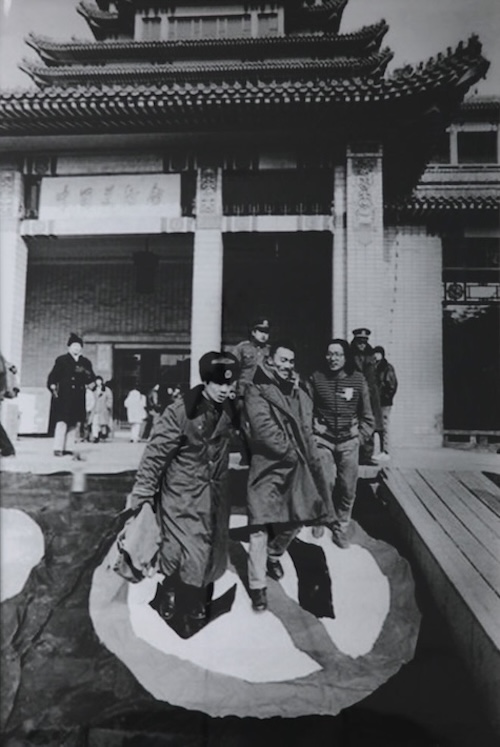
After the report of the gunshots, the first thing that happened was that Tang Song was mistakenly arrested.
When I had finished shooting, I left the scene by the left hand side and went to the lobby of the Art Museum. Tang Song happened to be on my left. Somebody suddenly appeared in front of us and grabbed Tang Song. I quickly turned and handed the gun to Li Songsong, shouting: “Songsong! Quick! Get the gun out of here. Get it out of here quick!” After this I quickly went and hid in the black box that was Zhang Yongjian’s (张永健) installation work Black Box – Guide to Destiny – Fortune Telling by Reading Moles (黑匣子-天命指南-由痣看命). I sensed that now something was about to happen.
Logically, if the police had seen me firing the gun, they would definitely have arrested me. The mistaken arrest of Tang Song was because they had heard the gunshots and, following the sound, had seen Tang Song and myself leaving the scene. They had come to the mistaken conclusion that firing a gun must have been the work of a male. And according to Tang Song, he said nothing when he was arrested at the Art Museum, which led to the fact of his being led away by the police. Hidden behind this mistaken arrest, seemingly so simple, there lies a subconscious social consensus: there is no way women could go and fire a gun.
In the black box of Guide to Destiny, only one door let in a dim light. I stayed in a corner. Somone came over and talked to me. I said I had fired a gun, and that something might happen, so I hoped that they would escort me out. I don’t recall who it was who went in front of me, but they surrounded me and walked me out of the black box. We exited by the back door of the exhibition hall of the Art Museum and made our way round to the square, and I left by the main entrance of the National Art Museum of China.
Arriving in the avenue, I crossed the street and entered the Baihua art supplies shop. I could still see the scene of Tang Song being arrested in the lobby. I ran to a public telephone and rang a friend who worked in some police department, but he happened to be out.
With sirens wailing, police vehicles rushed directly into the grounds of the National Art Museum. The scene before me was already something more complicated than just Tang Song being arrested. It was total chaos in front of the Museum.
I arrived at the Beijing Hotel and found Varbanov. I told him about what had happened at the National Art Museum and asked him how to handle it. He did not answer.
I returned to the National Art Museum. The main entrance was closed off. People could leave but not enter. A mixed mass of police officers and members of the public filled the square. Filling the street outside the Museum, a crowd looked on from behind a separating barrier. I was stunned by the scene before me. My thinking seemed short-circuited. My mind went blank. I panicked.
I got on a bus that went past the Baihua art supplies shop, and rode it from departure stop to the terminus and back several times. Each time it passed the National Art Museum, I felt extremely uptight. I could no longer see the black banners with the “No U-turn” logo, and the public had been driven from the square out into the avenue, so that there was nobody to be seen in the square, where a solemn silence reigned.
The sound of the gunshots again roused me and brought me back to the present reality. All that had transpired at the National Art Museum of China had to do with me, had to do with those shots I had fired. Yet I was behaving like a coward, hiding on a bus and not daring to face the facts. I had to go and explain. That awareness made me get off the bus.
I went to the small garden next to the Art Museum and happened to see my maternal aunt and her husband along with Li Songsong. They all urged me to surrender. Li Songsong gave me a camera and told me that it contained photographs that he had taken of the shooting (this camera was later confiscated by the police). Li Songsong gave me a ride on his bicycle to the National Art Museum’s entrance onto the avenue. I walked towards the National Art Museum.
While I was on the bus, my father had received a phone call from the Hangzhou police demanding a standard photograph of me to be used in a China-wide wanted-order. He returned home and asked my unsuspecting mother Song Ren for a photograph. She browsed through an album and carefully selected a portrait. My father was extremely impatient, grabbed a photograph and left. However, before the wanted-order went out, I had already surrendered.
After 4 p.m. that afternoon, a large crowd had gathered in the avenue outside the Art Museum. A notice stating that: “The China/Avantgarde Exhibition is closed due to an incident” had been hung on the fence outside the Art Museum. I later learned that Li Xianting (栗宪庭)23 had written it. Arriving at the entrance to the Art Museum, I told the guard: “I am Xiao Lu, I am going inside to surrender.” The guard wouldn’t let me in. Then I saw someone somewhat familiar in the distance, and I shouted: “Hou Hanru!”. The guard received an order to let me in.
Crossing the deserted square of the Art Museum, I ascended the steps into the Art Museum where many policemen surged towards me and took me into a room in the left wing of the Museum. A middle-aged man in plain clothes walked over and sat down on a sofa, saying: “Young lady, I know your father. Let’s have a little chat. Don’t be afraid.” Looking at the policemen who filled the room, I still felt rather nervous and asked: “Would it be possible for the policemen in the room to go outside?” He gestured with his hand: “All you people go outside.” After he had asked me a few details, he said I was to go with him. We got in a small police car, and I got out when we arrived somewhere. The plain-clothes policeman stayed in the car.
A female police officer led me in, searched me, took my fingerprints, photographed me and so on. Afterwards a police officer opened the door and came in and took me to another police vehicle. It was now dark as the car sped to the Dongcheng District detention centre. In a small room, a middle-aged man sat behind a rectangular table. There was a square stool in the middle of the room. He began to interview me, and a police officer took notes. It was all questions about the shooting. What struck me most was that after the interrogation, the police officer rose and came over and patted my shoulder. He said: “My son is studying painting. I am really worried that he might in the future do something like what you have done. Young lady, I just can’t get my head around how studying painting has led you to firing a gun.” He gestured to a policeman standing to one side: “Take her away.”
As I was being led down a long corridor, somebody was coming out of a door at the other end of the corridor. I recognised Tang Song! At a bend in the corridor, we both automatically stopped. He smiled and nodded to me. In that moment, that specific situation, a simple smile dispelled my nervous mood. A romantic mood of revolution welled up in my heart.
I was locked up in a small cell with two female criminals. Because I had been allowed to take my things with me, one of them asked me whether I had any money on me. She said she was in for corruption and hadn’t seen money for a long time. That day, jiaozi dumplings were served in the detention centre. They thought that as I had just gone in I wouldn’t have been hungry, and they negotiated that I gave them my jiaozi to eat, saying that they had never eaten their fill since being locked up. I spent the Chinese New Year’s Eve of 1989 starving.
In the detention cell, a low-watt yellow lightbulb dangled overhead. They sat on a bunk and played card games while I burrowed into the bedclothes. I don’t know what the time was when I was shaken awake and sat up in a state of confusion. The cuff port peephole in the steel door was opened, and I could only see some people looking in at me through it. They were saying something and pointing at me. I remember hearing one of them saying: “Yung lady, so you’re the one who fired the gun and jinxed our whole year from being good.” The following day I asked the warden who those people had been. She said they had all been high officials. The evening of that day I played poker with my two fellow inmates and thus whiled away the last hours of that year.
The first and second days of the year passed and on the third day tang Song and I were released. Na Dongyan (那东燕), an old fellow student from the Subsidiary High School of the Central Academy of Fine Art, signed the form when we were released.
There are many different opinions about the reason we were released. I don’t have any clear answer. On the whole, this matter was stirred up into something too big to be decided by single factor. In 1989 the enlightened image of China as a whole, the first collective appearance of Chinese modern art, the reports on this matter by various Chinese and international media. Of course, this matter also caused some people some trouble, for which I deeply apologise.
On 10 February, the National Art Museum of China reopened after a four-and-a-half day pause, and Tang Song and I went in. At the entrance we met Fei Dawei, who told me that: “The Voice of America on the evening of the same day reported the news about the exhibition, and the whole world knows about that gun.” Some reporters cornered me and asked me questions, #MeToo experience, all of them focusing on: “Why did you want to fire that gun?” Because I at the time had no way of facing the #MeToo experience underlying this work, or facing up to questions to do with the outside world, my thinking seemed to become jammed. Tang Song saw my evasion and panic.
Afterwards I learned that many news agencies around the world: AFP, AP, Reuters and other major international news agencies had all reported on the exhibition. In the only publications I have on hand, the US New York Times24, Washington Post 25, Times Magazine26, and the Japanese Monthly Art Magazine (Bijutsu Techo/美术手帖)27, the Hong Kong Yazhou Zhoukan (亚洲周刊)28, the reports on my work Dialogue all list the creator as Xiao Lu without any mention of Tang Song. The headline in the New York Times report published the day after the opening reads: “Police in China Art Show after Artist Shoots Her Works” – note the ‘Her’.
Gao Minglu (高名潞)29, whom we met in the left wing of the National Art Museum, suggested that Tang Song and I stay around to discuss this work in the presence of the reporters. And Li Xianting, whom we met later in the Art Museum, asked Tang Song and myself to come to his place.
When we arrived at the editorial department of Fine Arts in China (中国美术报) Li Xianting received us very cordially. It seemed that he was very excited by the shooting. Perhaps because I had been through too many events, I happened to have a bad headache at this time. Li Xianting arranged for me to sleep in an adjacent room while he and Tang Song talked. When I woke the day after, my brain was much clearer. Li Xianting had gone. I woke Tang Song, who was fast asleep and said I wanted to go to the Central Academy of Fine Art to get hold of Ju Yi and the video recording of the shooting performance.
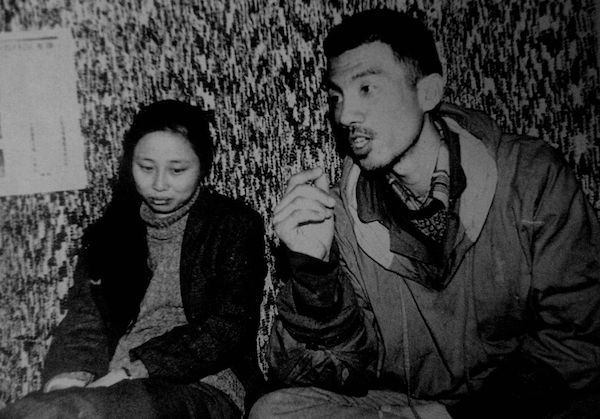
When we got to the dormitory of the Central Academy, everybody wanted to talk about the shooting. Facing so many people, my mind seemed blocked by something, I couldn’t open my mouth, my brain was full of feelings of shame, and all I could think of was how to find a hole to crawl into. A photograph from that time shows me with lowered head, while Tang Song was expounding freely on this work. Stuff about politics, law, strategy and a heap of esoteric vocabulary. I was completely struck dumb.
It was already late, and we needed to find a place to spend the night. I asked my old classmate Wang Yousheng (王友身) from the Subsidiary High School whether we could borrow two rooms, and I recall him answering: “Everybody knows you two are a couple, why are you putting on airs with me? This is the Central Academy…” and without further ado gave me one key. That was the day I got together with Tang Song.
The following day Tang Song suggested that we should immediately leave Beijing. I countered: hadn’t Gao Minglu hoped that we would stay around? Tang Song disagreed, he said we should formulate an explanation in writing. I said my mind was chaotic, and I wouldn’t be able to formulate anything clear. He said he would write it for me and afterwards let me sign it. At the time I really was rather dizzy. I didn’t read what he had written but just signed it “Xiao Lu”. Tang Song went out for a while, and when he returned he said that he had handed it to Gao Minglu. On the same day we left Beijing.
4. Confusion about the authorship of Dialogue
In the November, 1989, issue of Fine Arts in China Li Xianting’s first article was published under the title: “Two Gunshots: The Curtain Call of the New Wave in Art!”. The creators of Dialogue were given as “Tang Song and Xiao Lu”. Because I didn’t dare face up to the #MeToo motivation behind Dialogue, I was silent in the face of this erroneous ascription of authorship. This was my mistake.
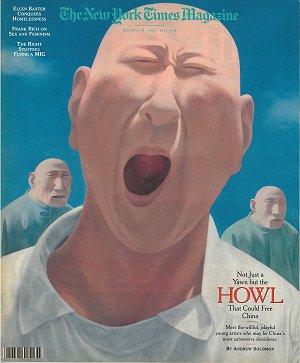
In Andrew Solomon31’s article “Their Irony, Humor (and Art) Can Save China” in the New York Times Magazine, (19 December, 1993), he writes in relation to the China/Avantgarde: “At the opening, two artists fired gunshots into their installation.” Here, my installation has become the work of two people, and my shooting has become the shooting by two artists. This was not true.
In 1998, in the exhibition “Inside Out” curated by Gao Minglu and organised by the Asia Society and the San Francisco Museum of Modern Art, the authors of Dialogue were listed as Xiao Lu and Tang Song.
On February 2, 2004, I wrote my first version of “Account of the shooting of the work Dialogue at the China/Avantgarde in 1989 at the National Art Museum of China” and I sent separate letters to Gao Minglu and Li Xianting. I announced that Dialogue was my work, not a collaboration. On April 16, 2004, Gao Minglu replied with a letter supporting that I was the sole author of Dialogue. On April 20, I published the correspondence on the “Art Alliance” (美术同盟)32 website.
The 2005 no. 208 edition of New Weekly (新周刊)33 under the heading of “Nodes in the History of the 1980s”, published an interview with Li Xianting, in which he stated: “In Beijing on February 5, 1989, during the China/Avant-Garde at the National Art Museum of China, Tang Song and Xiao Lu used a revolver to fire two shots at their work Dialogue 1 (the physical telephone booth)….” The fact is that it was Xiao Lu who fired two shots at her work, not ‘Tang Song and Xiao Lu’. This was a falsehood.
On October 14, 2005, Li Xianting’s “The Shooting Incident: interviews with some of the parties and a reinterpretation” on the “Art Alliance” website supporting Tang Song’s partial authorship of Dialogue. The article was published in vol. 1, 2006 of Arts Today (今日美术) magazine.
In the vol. 1, 2006 issue of Arts Monthly (画刊) magazine, Xu Hong’s (徐虹)34 article “SHE, THEY, HE” (她、他们、他) was published supporting Xiao Lu’s sole authorship of Dialogue.
On November 20, 2006, Gao Minglu published the article “A Lifetime of Gunfire – Half a Life of Dialogue”35 in Guardian Auctions Newsletter (嘉德通讯). Xiao Lu’s installation work Dialogue was sold at a Guardian auction for RMB2.31 million.
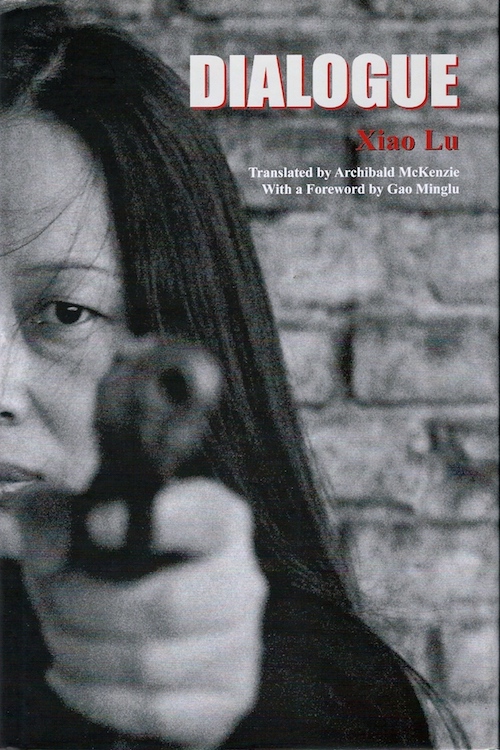
In 2010, Xiao Lu’s autobiographical novel Dialogue was published by Hong Kong University Press36, going public with the #MeToo experience of her youth.
On March 22, 2012, Liao Wen (廖雯)37 published the article “The Critical States of Tang Song”, in which the author set out her view that Dialogue had two creators. The creator who fired the two shots was Xiao Lu, but the author of the “Shooting Incident” was Tang Song. After the shooting many incidents occurred, and all the consequent effects of the shooting on relevant people and events were unrelated to the author of Dialogue.
On November 12, 2013, Dr Monica Merlin38, researcher with Tate Modern, London, interviewed Xiao Lu at the latter’s studio in Beijing. The interview was published on the Tate website.
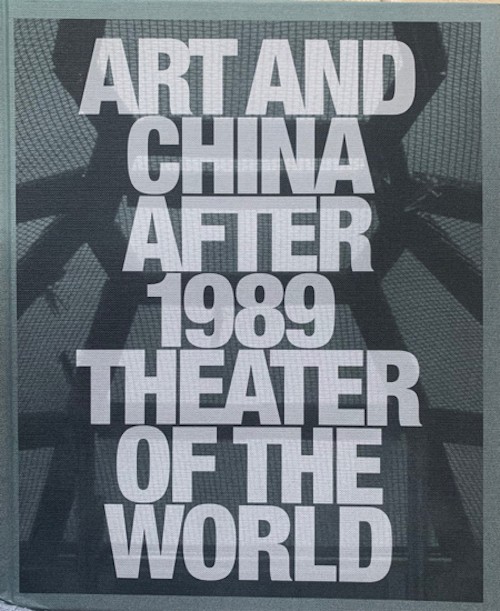
In 2017, Alexandra Munroe, Philip Tinari and Hou Hanru curated the exhibition Art and China After 1989 – Theater of the World, in which Xiao Lu’s work Dialogue took part.
In the 2018 Collection Display Performer and Participant at Tate Modern, London, Xiao Lu’s work Dialogue took part.
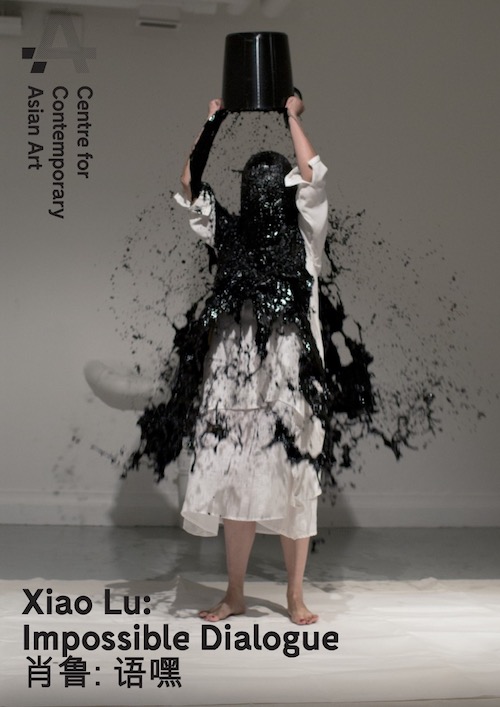
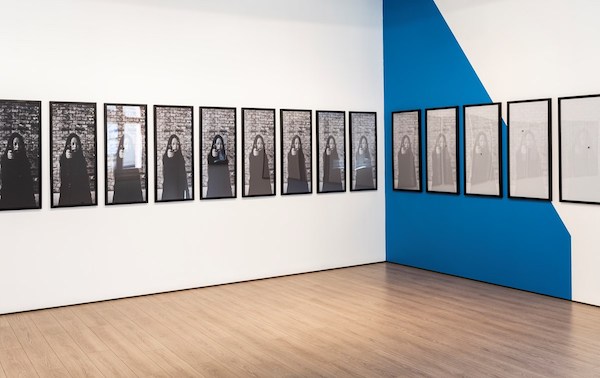
On January 19, 2019, on the ev of the 30 years anniversary of Xiao Lu’s shooting Dialogue, the 4A Centre for Contemporary Asian Art held a retrospective exhibition of thirty years of Xiao Lu’s Career under the title Xiao Lu: Impossible Dialogue (肖鲁:语嘿)39 and curated by Claire Roberts40, Mikala Tai and Xu Hong. It addressed the erroneous ascription of authorship of Dialogue.
In October 2019, the Collection 1970s – Present41 exhibition featured a photograph of Xiao Lu’s work Dialogue. On the MoMA website, Xiao Lu discussed her work Dialogue in a three-minute clip.
Tate Liverpool’s 2020 collection exhibition Democracies42, Xiao Lu’s work Dialogue took part.
In Hong Kong M+’s inaugural exhibition in November 2021, the exhibition M+ Ulli Sigg43 Collection – Four Decades of Contemporary Chinese Art, curated by Pi Li (皮力) the artist Yan Lei (颜磊) painted a huge work showing Tang Song being mistakenly arrested, using the historical documentary photograph as a blueprint. This painting was displayed in the section on the China/Avant-Garde of 1989, proving Tang Song’s importance to that exhibition.
In January, 2023 “An Interview with Du Xiyun (杜曦云)44: The Diversity of Contemporary Chinese Art Is Superficial, the Underlying Colour Is Hard to Eradicate”. This was a forum curated by Du Xiyun to review the forty years of Chinese Contemporary Art, and among the invited VIPs were Li Xianting and Liao Wen. In discussing the work Dialogue in the context of the 1989 China/Avant-Garde, and in reference to photographic evidence of the shooting performance, the authorship was divided between Xiao Lu and Tang Song.
Taikang Museum’s inaugural exhibition Entering the World: Chinese Modern and Contemporary Art Since the Twentieth Century (入世:20世纪以来的中国现当代艺术)in August 2023 featured Xiao Lu’s work Dialogue.
In September, 2024, the National Museum of Modern and Contemporary Art, Seoul, Korea held the exhibition Connecting Bodies: Asian Women Artists, in which Xiao Lu’s work Dialogue was featured.
Xiao Lu
February 2004, first version, Hangzhou, China, 2024 revised version, Sydney, Australia
Translated from Chinese by Archibald McKenzie
- Zhejiang Academy of Fine Arts, located at 218, Nanshan Road, Hangzhou, Zhejiang, China. Its name was changed to the China Academy of Fine Art in 1993.
- Zheng Shengtian (b. Henan, China, 1938). In 1958 he graduated from the Oil Painting Department of the Zhejiang Academy of Fine Art. In 1981, as one of the first visiting scholars from China’s art community, he pursued advanced studies and traveled in the United States, Mexico, and various European countries. He was at one-time Director at the Zhejiang Academy of Fine Art, and later served as Visiting Professor at the University of Minnesota and San Diego State University. He currently resides in Vancouver, Canada.
- Hu Zhenyu (b. Ningbo, Zhejiang, 1939). In 1956 he attended the Subsidiary High School of the Huadong Branch (Hangzhou) of the Central Academy of Fine Art. In 1964 he graduated from the Oil Painting Department of the Zhejiang Academy of Fine Art. From 1983-1986 he was selected to attend the Royal Academy of Belgium. As a professor of Oil Painting within the China Academy of Art, he was one -time Director of the Oil Painting Department. He currently resides in Hangzhou.
- Wang Chengyi (1930-2023). Born in Shexian, Anhui, China. In 1954 he graduated from the Huadong Branch (Hangzhou) of the Central Academy of Fine Art. Professor at the time in the Oil Painting Department, China Academy of Art.
- #MeToo (in Chinese “我也是”). In October, 2017, the New York Times and the New Yorker reported that tens of women had announced that they had been the subject of incidents of sexual harassment by the film producer Harvey Weinstein. This was subsequently widely promulgated by social media. Afterwards, people used the hashtag of #MeToo to publicise their own experiences of sexual assault.
- Xiao Feng (1932-2025), Born in Yangzhou, Jiangsu, China, father of Xiao Lu. In 1944 he took part in the Xin’an Brigade of the New Fourth Army. In 1950 he entered the Hangzhou National Academy of Arts to study painting. In 1954 he travelled to Leningrad, USSR, to study oil painting at the Repin Academy of Fine Arts. He was persecuted during the Cultural Revolution but was rehabilitated in 1970. From 1983 to 1996 he was the President of, and professor in, the Zhejiang Academy of Fine Arts (from 1993 called the China Academy of Art).
- Song Jianming (b. Fujian, China, 1957). In 1984 he graduated from the Dyeing, Weaving and Art Design Department of the Zhejiang Academy of Fine Arts. From 1984 to 1987, he furthered his studies in the École nationale supérieure des Arts Décoratifs, France. Former Director of the Dyeing, Weaving and Art Design Department of the Zhejiang Academy of Fine Art and Vice-President of the China Academy of Art. Currently resides in Hangzhou, China.
- The Shanghai Oil Painting and Sculpture Institute was founded in 1965. It operates directly under the Shanghai Municipal Culture Office and specialises in oil painting and sculpture.
- The organising committee of the China/Avant-Garde included the following members: Gao Minglu (chair), Gan Yang, Zhang Yaojun, Liu Dong, Liu Xiaochun, Zhang Zuying, Li Xianting, Tang Qingnian, Yang Lihua, Zhou Yan, Fan Di’an, Wang Mingxian, Kong Chang’an, Fei Dawei.
- Zhang Jie (b. Taizhou, Zhejiang, China, 1963). He graduated in 1989 from the Chinese Painting Department of the Zhejiang Academy of Fine Arts. In the 1980s he founded the “wall newspaper”. Subsequently he studied for a master’s and a doctoral degree. Former Dean of, and professor in, the School of Chinese Painting and Calligraphy in the China Academy of Art. Currently resides in Hangzhou, China.
- Tang Song (1960-2022). Born in Zhenjiang, Zhejiang. Graduated 1989 from the Chinese Painting Department of the Zhejiang Academy of Fine Arts majoring in landscape painting, lived with Xiao Lu for fifteen years from 1989 to 2003.
- Li Songsong (b. Beijing, China, 1973). In 1992 he graduated from the Subsidiary High School of the Central Academy of Fine Art, and in 1996 from the Oil Painting Department of the Central Academy of Fine Art.
- Song Cheng (1910-1941), Xiao Lu’s maternal grandfather, born in Rongcheng, Shandong, China. He joined the Chinese Communist Party in 1931 while a student at the Yanjing University, Beiping (Beijing). On December 24, 1937, Song Cheng started an armed uprising in Tianfushan, Shandong. He became political commissar in the Third Army of the Shandong People’s Anti-Japanese National Salvation Army.
- Li Yaowen (1918-2018), born in Rongcheng, Shandong, China. Admiral and one-time political commissar of the People’s Liberation Army Navy. Song Cheng’s comrade-in-arms.
- Song Ren (1932-2025). Xiao Lu’s mother, born in Rongcheng, Shandong (ancient name: Lu, which is the reference of Xiao Lu’s given name). In 1954 went to study in the Oil Painting Department of the Central Academy of Fine Art, Beijing, after which she stayed on at the Academy as a teacher of oil painting. In 1959, after she and Xiao Feng were married, she was transferred to teach in the Oil Painting Department of the Zhejiang Academy of Fine Arts.
- Yin Shuangxi (b. Tai County, Jiangsu, China, 1954). In 1989 he was on the Committee of the China/Avant-Garde. He completed his doctorate degree in 2002 from the History and Theory Department of the Central Academy of Fine Art. Professor in the History and Theory Department of the Central Academy of Fine Art. He currently resides in Beijing.
- Yu Jiyong (1956-2021), born in Shanghai, China. He graduated in 1979 from the Sculpture Department of the Zhejiang Academy of Fine Arts and was employed in the Shanghai Institute of Oil Painting and Sculpture in 1986. His work Composition 8510 was selected for the 1989 China/Avant-Garde. For a year was the colleague of Xiao Lu at the Shanghai Institute.
- Fei Dawei (b. Shanghai, China, 1954). He graduated in 1985 from the History and Theory Department of the Central Academy of Fine Art, and then stayed on at the Academy to teach. He was a member of the Committee of the 1989 China/Avant-Garde. Master of Fine Arts from Paris VIII University. Artist and curator. He currently resides in Paris, France.
- Ju Yi (b. Shanghai, China, 1963). From 1979 he attended the Subsidiary High School of the Central Academy of Fine Art in Beijing and became a classmate of Xiao Lu. He currently resides in Beijing, China.
- Wen Pulin (b. Shenyang, China, 1957), he graduated in 1985 from the History and Theory Department of the Central Academy of Fine Art. In 1989 he recorded videos of the China/Avant-Garde. He was present and photographed and videorecorded Xiao Lu’s shooting of her work Dialogue. He currently resides in Beijing, China.
- Hou Hanru (b. Guangzhou, China, 1963). Attended the History and Theory Department of the Central Academy of Fine Art, graduating with a master’s degree. Member of the Organizing Committee of the 1989 China/Avant-Garde. In the 1990s, he moved to Paris, France, where he still resides and works as a curator and artist.
- Maryn Varbanov (1932-1989). Born in Oryahovo, Bulgaria. Graduated fom the National Academy of Art in Sofia in 1953, then studied in China at the Central Academy of Fine Art and the Central Academy of Arts and Crafts, achieving a master’s degree. In the meanwhile, he married Song Huaigui and later lived in Paris, France. In 1986, he formed the Wan Man Institute of Wall Hanging Art at the Zhejiang Academy of Fine Arts. He became acquainted with Xiao Lu in 1986.
- Li Xianting (b. Jilin, China, 1949 ). During the later stages of the Cultural Revolution he became a “worker-peasant-soldier” student of the Chinese Painting Department of the Central Academy of Fine Art, specialising in human figures. He was a member of the Organising Committee of the 1989 China/Avant-Garde, and was Editor of Fine Arts in China (中国美术报). He resides in Beijing, China, where he works as an art critic and curator.
- New York Times International of February 6, 1989: ”Police in China Close Art Show After Artist Shoots Her Works”.
- Daniel Southerland: ”China’s Dada Shock” in The Washington Post, February 13, 1989.
- Reported by Jaime A. FlorCruz/Beijing。 Edward M. Gomez, reported by Jaime A. FlorCruz/Beijing: “Condoms, Eggs and Gunshots” in Time March 6, 1989, p44.
- Cai Guoqiang in Bijutsu Techo (Art Manual/美术⼿帖), Japan: 北京から (“From Beijing”).
- Yazhou Zhoukan (Hong Kong), March 5, 1989, p24: “Modern Art Exhibition Stops and Starts Under Gunshots”(现代艺术展枪声下停停开开).
- Gao Minglu (b. Tianjin, China, 1949). Chaired the Organizing Committee of the 1989 China/Avant-Garde, former Editor of Art Magazine(美术). Art historian, theorist and curator. Doctorate from Harvard University, MA. Professor in the History of Art and Architecture Department of the University of Pittsburgh, PA. Currently resides in Pittsburgh, PA.
- Wang Youshen (b. Beijing, China, 1964 ). From 1980 attended the Subsidiary High School of the Central Academy of Fine Art. Classmate of Xiao Lu. Former Editor of Beijing Youth Daily (北京青年报). Currently resides in Beijing, China.
- Andrew Solomon (b. New York, NY, 1963 ). Writer on American politics, culture and psychology. Has written for New York Times, The New Yorker, Travel + Leisure and other publications on a series of topics. For the New York Times agazine, he wrote the article: “Their Irony, Humor (and Art) Can Save China”. Link: https://andrewsolomon.com/ articles/their-irony-humor-and-art-can-save-china/
- 美术同盟 (Meishu tongmeng, Art Alliance) www.arts.tom.com This website, edited by Wu Hong (吴鸿), no longer exists.
- The interview by Hu Fei (胡斐) with Li Xianting (栗宪庭) was published in New Weekly (新周刊), 2005, no 208: “Nodes in the History of the 1980s” (1980年代历史节点) under the title of: “The Two Gunshots That Ended the ’85 New Wave”. Link: https://news.sina.com.cn/c/2005-08-02/18157393103.shtml
- Xu Hong (b. Shanghai, China,1957). Graduated 1985 from the Oil Painting Department of the Shanghai Institute of Oil Painting and Sculpture, majoring in oil painting. 1991-1992 furthered her studies in the Teaching Assistant Training class in the Art History Department of the Central Academy of Fine Art. Research Fellow in the National Art Museum of China. Researches female artists. Currently resides in Beijing, China.
- Link to the article “One Gunshot – Half a Lifetime of Dialogue”(一声枪响——半生对话) http://www.artresearchcenter.org/index.php?m=con tent&c=index&a=show&catid=39&id=32
- Hong Kong University Press, autobiographical novel Dialogue (对话) Link: https://hkupress.hku.hk/index.php?route=product/product&product_id=1436
- Liao Wen (廖雯) (b. Chengdu, Sichuan,1961). Graduated from the Chinese Department of Beijing Normal University. Curator, critic, researcher in female artists. Li Xianting’s (栗宪庭) spouse. Currently resides in Beijing, China. Link to her article: “The Critical States of Tang Song” (唐宋的临界): http://www.art-woman.com/CriticAr ticalDetail.aspx?cid=9&atype=1&aid=86
- Monica Merlin (b. Italy). She completed her doctorate at the University of Oxford in 2013. She was a researcher at Tate Modern, UK, 2013–2014. She is currently Associate Professor in the Art History Department of the Virginia Commonwealth University School of the Arts in Qatar. She is a Research Fellow of the China Centre for Visual Arts and Birmingham School of Art. She researches contemporary art and visual culture in China, especially female artists, feminism, and gender. Link to Dr Merlin’s interview with Xiao Lu for Tate Modern: Xiao Lu 肖鲁 | Tate or https://www.tate.org.uk/research/research-centres/tate-research-centre-asia/women-artists-contemporary-china/xiao-lu
- 4A Centre For Contemporary Asian Art, Sydney Australia, link to solo exhibition: https://4a.com.au/exhibitions/xiao-lu-impossible-dialogue-xiao-lu-yu-mo
- Claire Roberts (b. Melbourne, Australia, 1959) Received her PhD from the College of Asia and the Pacific, Australian National University, ACT. Currently Professor in Art History and Curatorship in the University of Melbourne. Studied 1979 to 1981 at the Central Academy of Fine Art, Beijing, where she began her research in China’s culture and contemporary art. Art historian and curator.
- Museum of Modern Art, New York: Museum Collection: 1970s-Present. Link: https://www.moma.org/collection/works/114901
- Tate Liverpool: Collection Exhibition: Democracies. Link: https://www.tate.org.uk/whats-on/tate-liverpool/tate-liverpool-free-collection-displays
- Uli Sigg (b. Luzern, Switzerland,1946). LLD, University of Zurich. Businessman, diplomat, art collector. Swiss Ambassador to China, South Korea and Mongolia 1995-1998. He collected many contemporary Chinese artworks, of which he donated a large number to M+ art museum, Hong Kong.
- Du Xiwen (b. Shanxi, China, 1978). Graduated 2006 from the Art History Department of the Sichyan Academy of Fine Arts. Art critic, magazine editor, curator and so on. Currently resides in Beijing, China. Du Xiyun interview link: https://mp.weixin.qq.com/s/jh5WDQv0RuNPxJFXSGbv6A