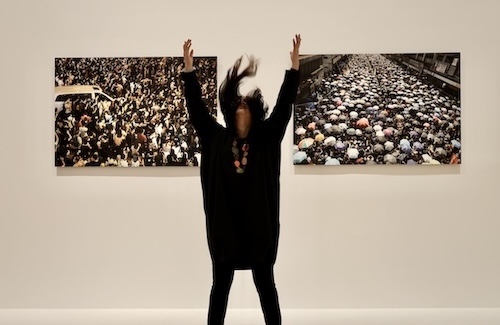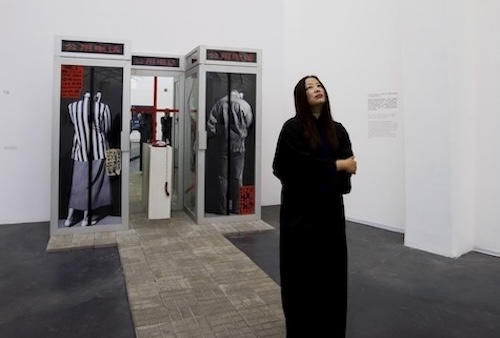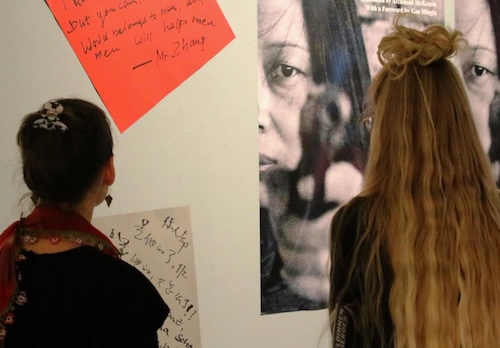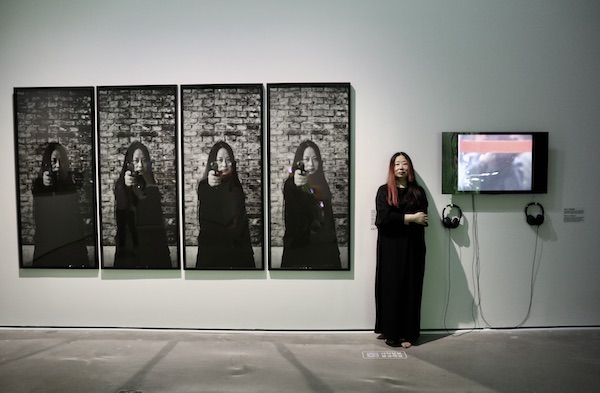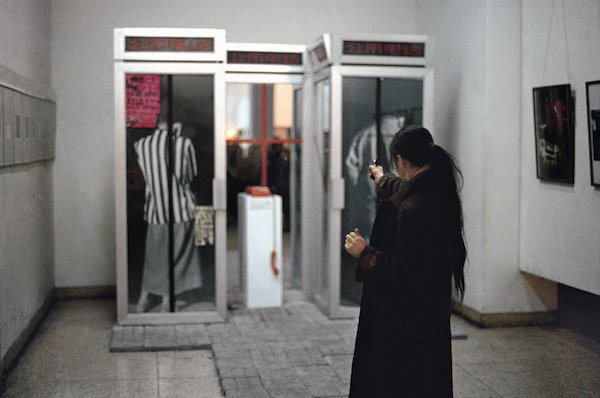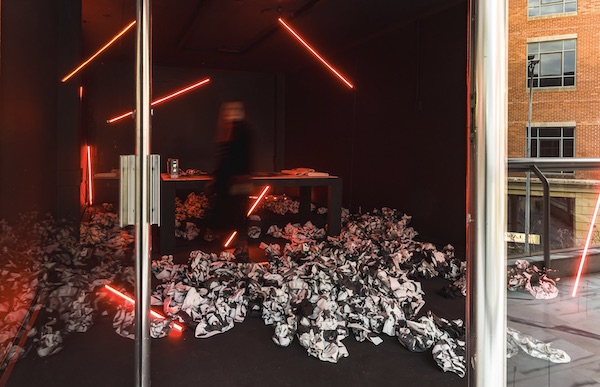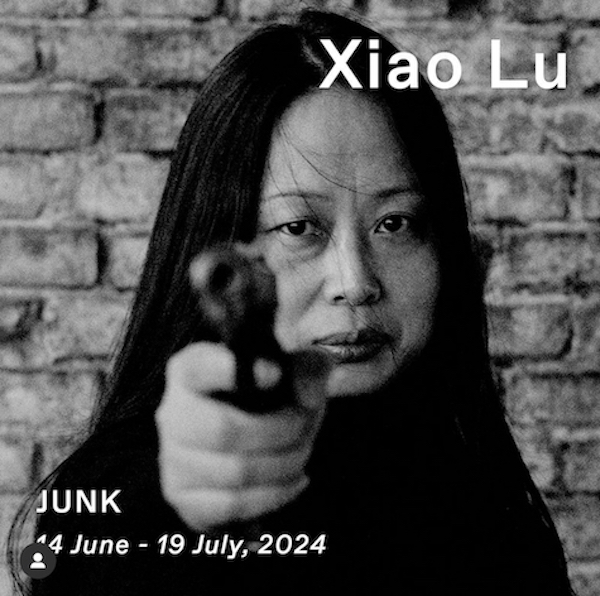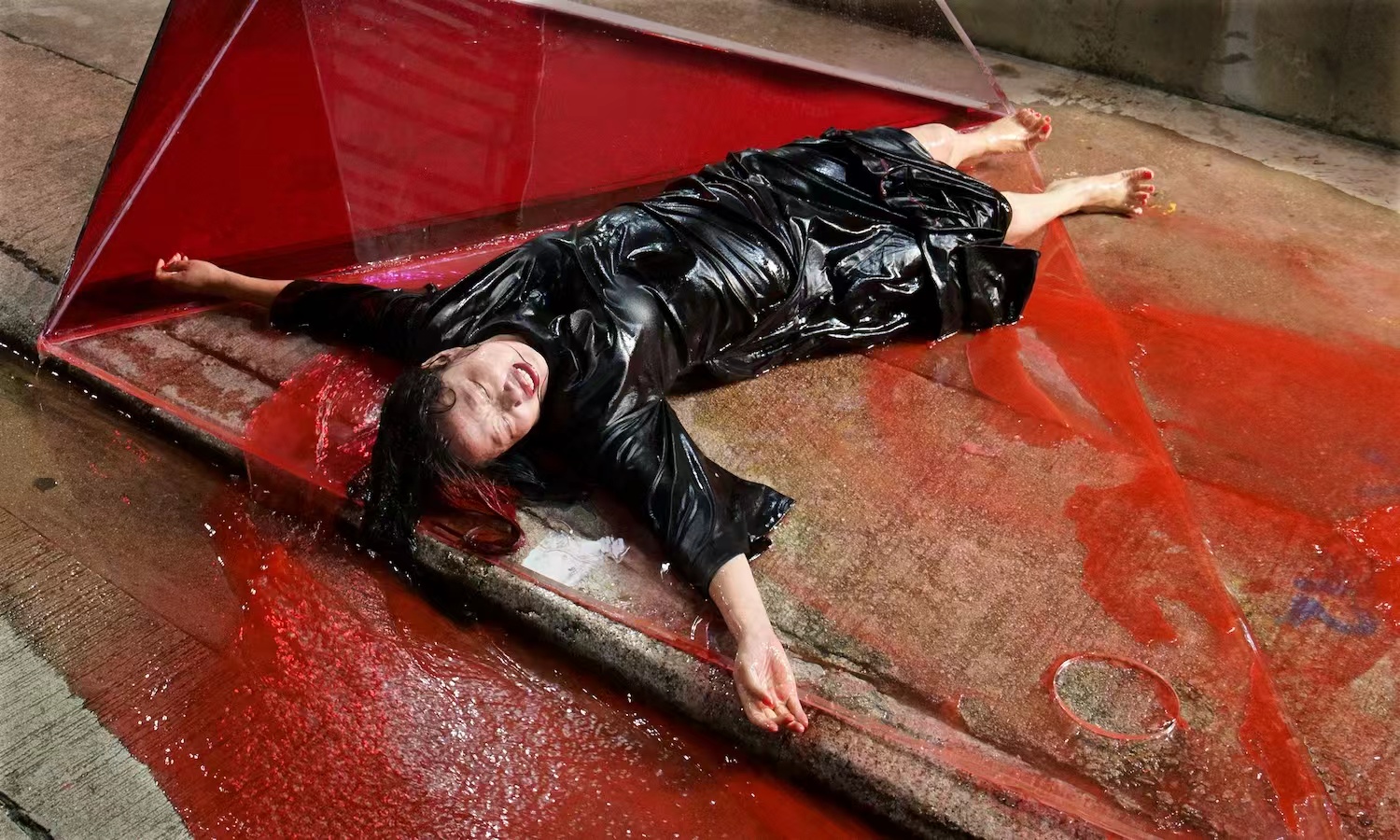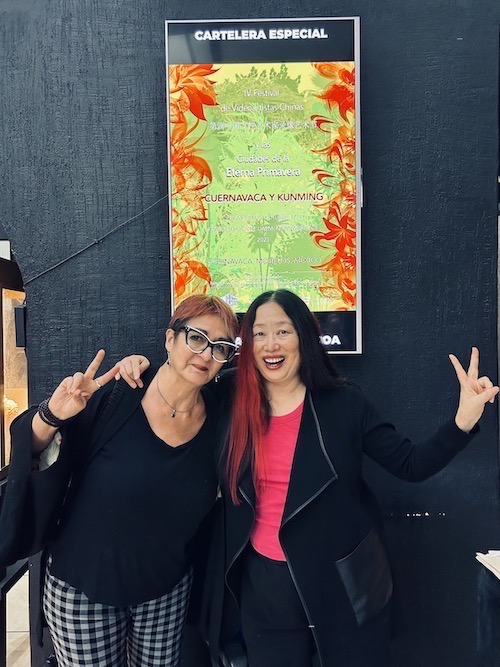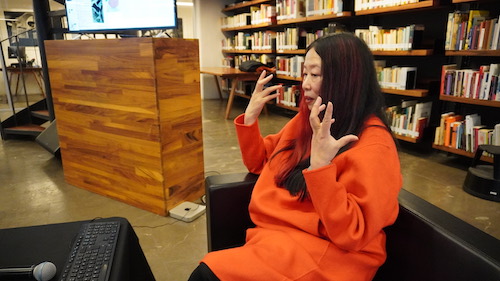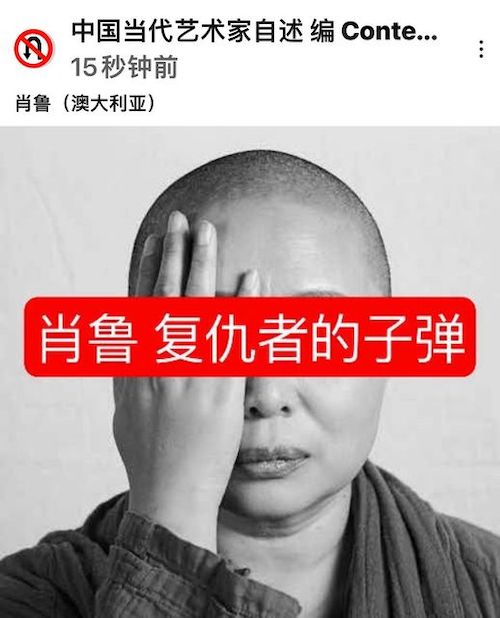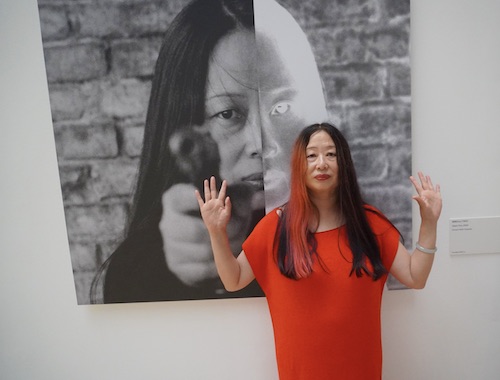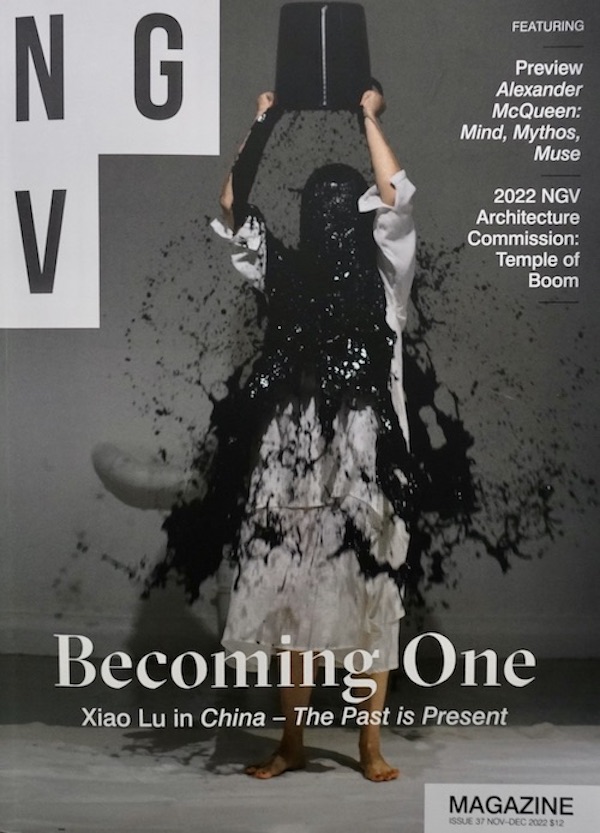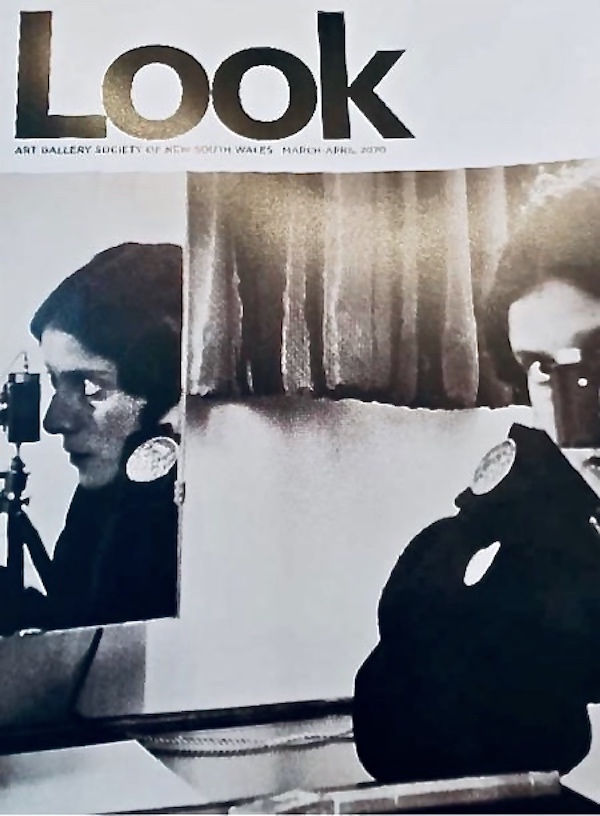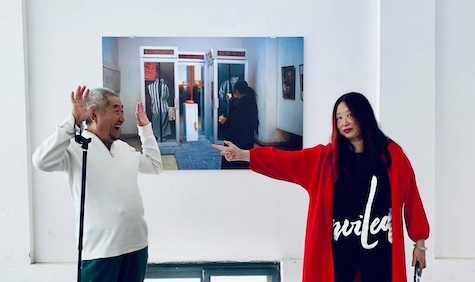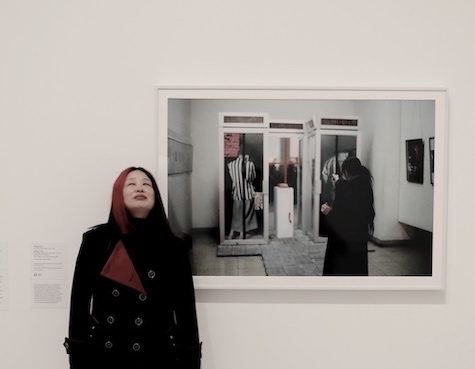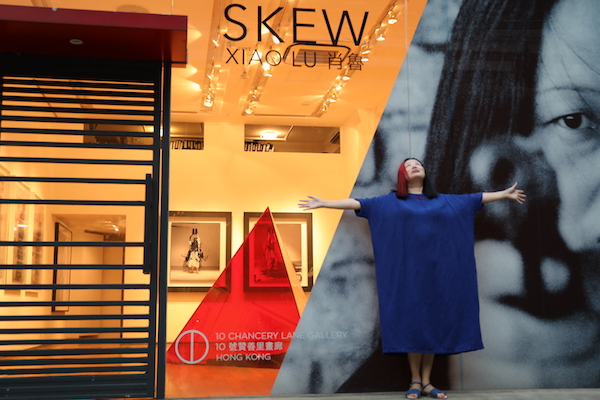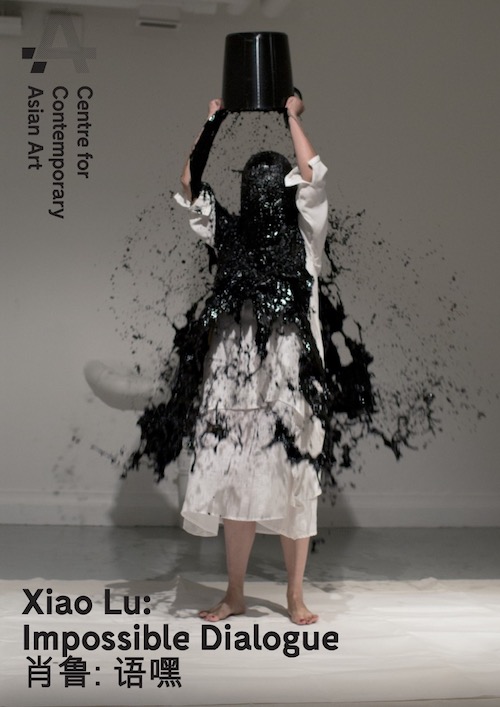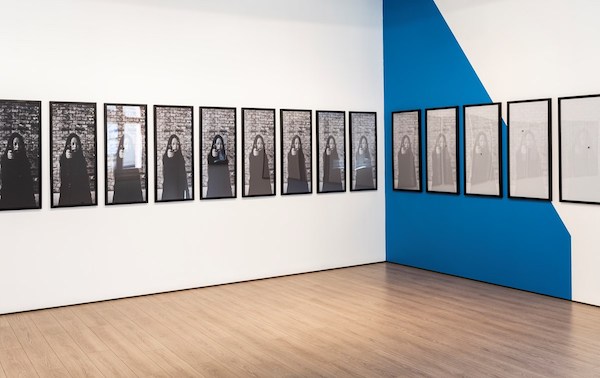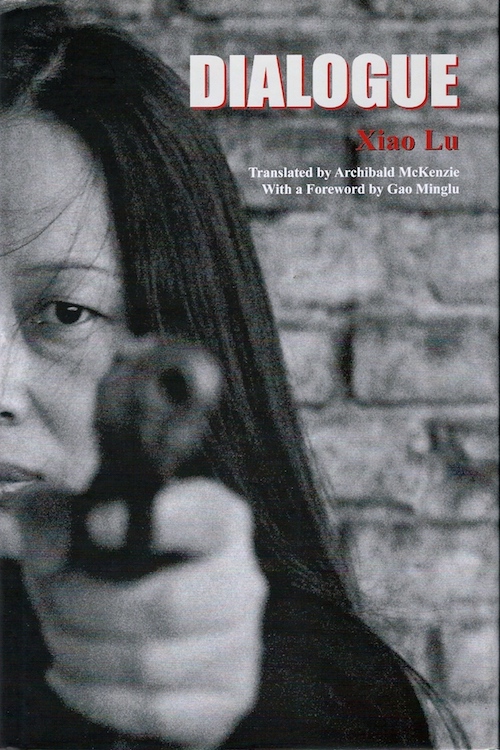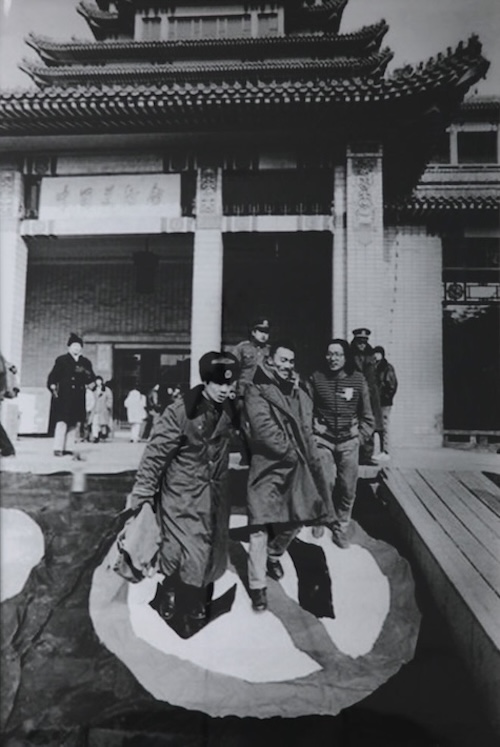
First letter from Xiao Lu to Gao Minglu about the shooting of her work Dialogue at the National Art Museum of China, Beijing, in 1989.
To Mr Gao Minglu [高名潞]: Greetings!
The re-creation of the work Dialogue (对话) is complete. For the time being it is in my studio in Dashanzi, Beijing. I have now returned to Hangzhou.
On the 15th of last month, I held a “party”(in English) to celebrate the completed re-creation of Dialogue. Li (栗, that is, 栗宪庭, Li Xianting) was also there. He said he was in the process of carrying out a revision of some outstanding historical issues, and proposed to interview me. This is the first time in fifteen years that he has come to interview me, and is also the first time I have talked to him about the real sequence of what occurred at the shooting incident.
Mr Gao, I remember how, when I last met you in Beijing and suggested that I would like to see what the outside world said about this work, you said: “You do not have to see anything. You are the creator. You should write the truest account.”
Every time I took up my pen, what I felt in my heart was difficult to express in writing. This was a stretch of history that was closely linked to my personal emotional life and to the history of Chinese modern art, and I found it impossible to deal with.
Mr Gao, when I had settled down a little, I adopted an objective attitude and wrote that “Explanation of the Shooting of the Work Dialogue in the National Art Museum of China, Beijing, in 1989” (关于1989年在中国美术馆枪击作品《对话》的说明). Perhaps I made errors in numerous specific conversations and details, but I was quite clear about the larger events.
In recent days I have repeatedly recalled the situations and my real state of mind in that year, and I feel that am someone who a very high degree follows her feelings in doing things. My emotions led me to create the original Dialogue. What made me want to fire that gun was emotion. Emotions made me not say a single word to the outside world for fifteen years, and now it is still emotion that makes me speak about the true circumstances shooting incident to you, to Li and to others. When I look clearly at all this, I not only ask myself what the connection was between the background of these true situations and my inner world. I don’t know how I should explain myself with regard to this historical mistake. As Li asked me: “At the time, when I mistakenly added the name of Tang Song (唐宋), why didn’t you say something?” “Because he and I had become a couple.” My answer leaves both of you non-plussed, I am sure. I don’t know what in this world is, for men and women, the most important thing in their lives.
When I was writing up a series of random factors in the Shooting Incident, I couldn’t help asking myself, against the background of all this randomicity, which elements were necessary? From the position of art history, there was at least this one point: it was not a pre-meditated incident, let alone an incident that Tang Song had planned. Tang Song was only relevant to the incident, and he was completely irrelevant to the begetting of the work. Mr Gao Minglu, if I were a highly rational person, if I had so thoroughly thought out the consequences of this shooting, I should perhaps never have fired the gun, for after all, it was in breach of the law. If it had been in a country with a properly functioning legal system, Li Songsong (李松松) and I might have received a jail sentence. Li Songsong lent me the gun and I fired it. As for Tang Song, he was at most someone with inside knowledge. It was exactly because I was in the China of that era that I had no legal conceptions in my head, and it was exactly the uncertainties of the law in China that led to the social character of this work.
In fact, when I think back on the events of that year, many of the connections between chance and necessity were indispensably linked. The apparently random events were closely interlocked, and if any one of them had been missing, the gun-shot incident could never have taken place. However, the main thread that ran through all of them was my inner need, for even if it had been at someone else’s suggestion or prompting, none of all this could have taken place without that inner need that one has: you have the right of choice between doing something and not doing it, and ultimately there is something that needs you to fire that gun.
I don’t know how the outside world discussed this work. For so many years, I have read very little about it, and the little I have read has been fortuitous. It also feels very foreign to me, and on the whole I feel that these writings have little to do with me. Indeed, the true meaning of this work lies in its quality of having been reproduced. It is a life that I conceived, yet its extension has already transcended the significance of the work in itself. As for myself, it extends to the present. The time when I recreated the work turned out to be a time of facing up to, and dealing with it again. The emotional life of fifteen years earlier, which had taken Dialogue for its medium, became an ending through Dialogue. If one were to take a deterministic view of it, it would simply be a vicious circle. A fortnight after Tang Song formally raised separating from me, a telephone call from Beijing came requesting that I reproduce this work. When Tang Song became aware of this, and again wished to control this work, I firmly said: “No!”
Mr Gao Minglu, I don’t know what kind of business everything I am saying today is from the point of view of your and your colleagues’ art history. As you said, it involves two kinds of discourse, but my feelings are at such a loss. Indeed Dialogue is a work made by a woman but spoken about by a man.
When you see certain things clearly, or when you have lost certain things, then what is important for oneself? What is real? To use the current expression: I had no choice. Mr Gao Minglu, in art and society, in art and the individual, between men and women, everybody is looking for a point of reference. If the point of reference I thought I had was shattered, what was the significance of ‘the meaning of life’ for me? When I negated all the past with Fifteen Gunshots, what did the future mean for me? Was it still the same as that year when, having finished shooting, I was still not very clear about the consequences to which that had given birth?
I cannot say for sure. The moment when you deal with a period of history, you nevertheless feel so helpless. People suddenly become very small, somewhere and somehow you seem to be pushed along by history, and you also seem to be interconnected with history. In that case, the fragments of history and thought, in many interconnections and mutual checks between points in the darkness, are telling me that all misreadings between objectivity and subjectivity in history become possible. Each individual person, applying her or his insights into life within her or his limited space, must interpret her- or himself and others, and at the same time deal with history.
Mr Gao Minglu, many people ask me: “Why did you have to fire the gun?” It is very difficult to explain in one sentence. I think that for me, art is perhaps a means of saving myself, a device of survival. The form of firing a gun happened to coincide with my inner needs. It allowed me a temporary respite. I suppose that this has to do with psychology.
Mr Gao Minglu, there is something I cannot work out. Is a work of art based in the human being? Or is it based in its meaning? In modern art, is it how things are said that is important, or how things are done? I think that these are two lines of thought, but that the second must depend on the first. Perhaps some people created works taking the second line as their starting point. I don’t know. However, speaking for myself, I think that if I hadn’t produced that work at the time, if I hadn’t done my best to get hold of a gun, if I hadn’t fired the gun, then would nothing that happened later have eventuated, and would all meaning have been out of the question? There is now a phenomenon of the curators leading the artists. Perhaps my problem that year lay there: the artist had disappeared.
I hope to receive your guidance on this.
Xiao Lu,
Lower Manjuelong, Hangzhou, 4 February 2004.
Xiao Lu’s second letter to Gao Minglu about the shooting of the work Dialogue at the Chinese National Art Museum (Beijing) 1989.
Dear Mr Gao Minglu,
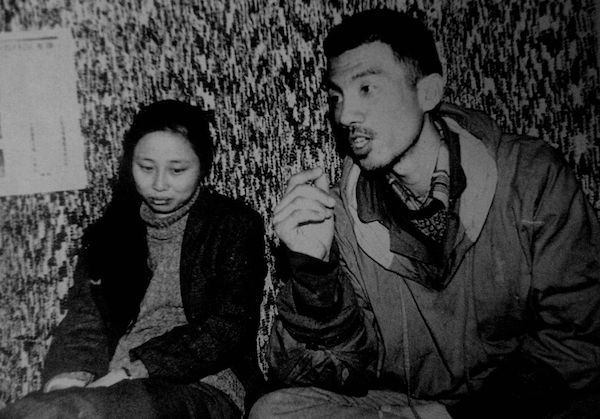
In a book Trends published in Taiwan, there is an article written by you about the China/Avant-Grade in 1989. There is a photograph in it that reminds me of certain states of mind I experienced that year. In the picture, Tang Song (唐宋) is holding forth while I sit beside him with my head lowered. The presentation in the photograph is indeed a very true record of us at the time. It dates from the day after we talked to Li (that is, Li Xianting, 栗宪庭). On the evening of that day we were in a dormitory of the Central Academy of Fine Arts. If I remember correctly, Fei Dawei (费大为) was also present, and that’s when the picture was taken.
Perhaps there is a phenomenon that I indeed created. As for the circumstances at the time, when we came out of the Dongcheng Detention, how to explain this work was an urgent priority. Although I was very clear about the state in which I had created this work, I had before the shooting been completely incapable of foreseeing the state of affairs that developed afterwards. The size of the wave generated by this ball had already completely bamboozled me. I remember facing you theorists at the time and really suffering from stage fright. Tang Song on the other hand was much more alert to what had occurred. He grasped the right to the discourse and interpreted this work according to his own format, thus becoming its spokesperson. As for my state at the time, I was actually really rather dizzy, which was another reason why he could intervene. For these fifteen years I have not said a word in public. In fact, this means I relinquished the right to the discourse from the beginning. A great big lie enveloped this work, and I didn’t know how I should explain it. Its real connection with me was in fact this period in my emotional life.
Mr Gao, I am thinking whether the reason why this work is influential is that its social character is the main factor established by it, but if I am allowed to say something against my will, before I had made this work, how could I have foreseen the future. This would be untrue in my case, because this gun was only a fruit that I threw, that’s all, but the size of the splashes raised by it was a product of the particular historical situation.
Sincerely yours with all best wishes,
Xiao Lu, Manjuelong, Hangzhou
25 February 2004.
Third letter from to Xiao Lu to Gao Minglu about the shooting of her work Dialogue at the National Art Museum of China, Beijing, in 1989.
Dear Mr Gao Minglu,
In our conversation, you suggested clearing up some matters through the format of an exchange of letters, and you hoped that I would be able to write some things down. People are like inductors: they present various discourses according to their various mental states. I sometimes wonder whether the purpose why I am desperately looking for a result is to achieve a fair statement or a path of self-liberation. I am like someone who has fallen into an abyss and is praying to heaven. At the same time I am unable to resolve a series of questions and can only dissect my inner world one question at a time. Because it is closest to me, I can touch its pulse and know whether it still exists.
The world is made up of men and women. According to traditional Chinese conceptions, they should undertake different roles. Looking through China’s history, with its plot after plot to usurp power, between plotting big and plotting small, the words of absolution sought to justify all the devices, sometimes really appear so pale and weak. Within this kind of consciousness, it is somehow perfectly justifiable to seek fame and fortune by any means. I am not someone who cares for fame and fortune. In asking history today to return the reputation that should have belonged to me all along, it is the format of Tang Song’s behaviour that has made me see a world that I wish neither to face nor to accept. I despise what he did from the bottom of my heart. To that phrase of mine of the time, “It’s OK with me” (我愿意), I have added a heavy “NOT” (不).
Simone de Beauvoir in her book The Second Sex (Le deuxième sexe) writes: “One is not born, but rather becomes, a woman.” (“On ne naît pas femme, on le devient.”) My experience on the other hand is that one is born a woman. The inborn maternal character of women gives us an instinct for self-sacrifice. As long as she is willing, she is capable of giving up all of herself. A popular saying goes: “Man is heaven, woman is earth.” However this must be a true heaven, in which case, the earth under it will encompass all of it. Heaven and earth become one, which originally should be the most favourable natural state. What need then to overthrow heaven? Mr Gao Minglu, I am an idealist and dedicated to love. It is the demand in my nature for an unreal vision. From my raising the gun again and again, one may see the extreme limits of what my inner world cannot accept. People grow between heaven and earth. The formats of their actions are closely linked to nature. Cause and effect correlate to one another, which nobody can change. The human heart is like an atomic core. Only you yourself know what’s in that core. It may ignite. It may emit light. At the same time, it may explode.
Xiao Lu, 19 March 2004.
Fourth Letter from Xiao Lu to Gao Minglu on the 1989 shooting of her work Dialogue
Dear Mr Gao Minglu: greetings!
Two days ago I moved from my parents’ place to a dwelling opposite the tea hills. This welcoming breeze freshly blowing in my face has led me to sit down and write the following words to you in one sitting, but after a friend visited me, I found it impossible to finish them. This made me think about the ever-present relationship between nature and man, and artworks and nature; that is about natural things in special circumstances.
A small rain is falling outside my window, and I can hear delicately chirping birds. This long-absent air gave me a temporary peace. I have found a tacit reciprocal understanding between myself and nature, living and growing in accordance with what comes naturally. The suffering and joys of the human world change suddenly like the weather. Human life from birth to death follows a law of nature. The line between life and death is contained in only a thought. It is better to say that one experiences life and death than that one experiences human life. In the process of seeking life, I seem to have found some meaning with life. Human life is merely a process from birth to death. If you uses your heart to experience it, its sweetness and bitterness will be so real that you will feel where every point of pain lies. To record every moment of life naturally and truly, and that record might be called “art”, I suppose. I don’t know.
Mr Gao Minglu, in fact every person employs the format that they know best to interpret life. Everybody is searching for the door that allows them to access wisdom. In this process, everybody’s state of mind is different, so that the viewpoint of interpretation is also different for each person. I do not believe that anybody can fully enter into another person’s mind, because the circumstances and the tracks of each person’s life are different. There will perhaps always exist misreadings in the mutual understanding between two people, and all the disasters in the world perhaps occur from such misreadings. Harmony vs conflict, ideals vs realities: perhaps the progress of humanity is born out of these repeated confrontations. Sometimes I feel I should be grateful to the travails of my life. They have allowed me no way back. That urge to survive gives me a certain strength to resist certain things that I cannot accept.
The gunshots of fifteen years ago were fired at the me in the mirror, but the gunshots of today are fired at my own true self. This process may be my true process of maturation. The me of fifteen years ago was still a person who did not dare face the world and talk about herself. Perhaps the real reason I didn’t dare open up was female shyness. I hid myself. My not telling the facts was due to my not daring to do so. That photograph of myself with lowered head tells me all this. On this point I have suddenly found an answer today. Mr Gao Minglu, if I am to write this history, please do not seek out anybody else to take responsibility for it. All this was caused by myself only. I lacked the courage to face reality. I was aviding something. I hoped love could save my soul. My ignoring the facts was actually a device by which to avoid reality. Mr Gao Minglu, maybe God needed to use this format to make me realise all this. It forced me to face the relationship between history and myself. In the face of so great a historical event, its depth should not be measured in terms of individual grievances. It was what I didn’t say that led to all this today.
Mr Gao Minglu, I am an emotional rather than a rational person, and I engage with many of my matters on an intuitive basis. For more than half a year now, my state has led me to lose my rational judgement of things. In my unbalanced state, I am seeking the point by which I can balance myself. I consider the emotions associated with the beginning of my relationship with Dialogue as the ultimate cause of the present consequences. This historical event that is so complicated is like a web that entangles me in a knot that I cannot untie. Perhaps it is like the title of that article of yours, the ‘madness of 1989’. It is as pure and simple as trying to find hope in people’s madness, and asdirectionless. Passion is the most precious memory that is left me from that era.
Not long after we returned to Hangzhou after the ‘shooting incident’, the ‘Students’ Movement’ began. Consequently, we had a very unusual experience. This is a stretch of history that I cannot forget even till today, and it was also the foundation on which I maintained that emotional relationship. I don’t believe that an emotional relationship that is built on shared hardships can be destroyed in a day. It was onbly when he used any means of hurting me to break up the relationship that I truly realized that the great edifice of our emotion was constructed on such vulnerable ground. In these fifteen years, he didn’t want marriage, he didn’t want children, and I accepted all of it. I regard love as an ideal to realise in one’s life. I regard it as very important. I truly managed a state of forgetting myself. This unrealistic attitude of mine made it impossible for my family or friends to understand me. However, in my heart I understand why this was so. I was weaving a dream for myself, and all I needed was a ray of hope….
Mr Gao Minglu, I have fully awoken from this dream. The irreversible ending is my present awakening. I have returned to myself. My new understanding of the ‘shooting incident’ allows me to begin to face myself. I am no longer that Xiao Lu who was living in self-deception and deception of others. At the same time as I dare to face this emotional history in myself, I also dare face the history of the ‘shooting incident’. Mr Gao, I am not a historian, but I think that history is formed by people, and a new understanding of history should be a new understanding of people in the history in which they are. Of course this does not eliminate subjective prejudice, but fortunately that stretch of history is not yet too far removed from us, and I am willing to serve as a winess of that history and to assist you in assessing the products of that particular historical state of things in a relatively objective way. Please do not show consideration for my position. My resilience today is strong enough to face anything head on. I suggest that you could also make inquiries from Tang Song and reach your assessment based on his answers too.
I have written so much, yet I don’t know whether I have made myself perfectly clear or not. I never expected that the Xiao Lu who at that time met you theorists with so much trepidation, should today dare to write letters to a theorist. Can that Xiao Lu who didn’t dare to speak at the time, have grown up and matured today? Mr Gao Minglu, I am very grateful for this suggestion of yours, which gives me the opportunity to sort out myself. I am finding that writing is an excellent method for this purpose.
Yours respectfully,
Xiao Lu
Manjuelong, Hangzhou, March 23, 2004
First published April 20, 2004 on the Arts Alliance
(Meishu tongmeng, “美术同盟”)
website http://arts.tom.com
Translated from Chinese by Archibald McKenzie